Broadly speaking, infrastructure encompasses the essential physical assets and systems that serve as the backbone to our societies and economies, enabling everything from transportation and communication to global commerce and artificial intelligence.
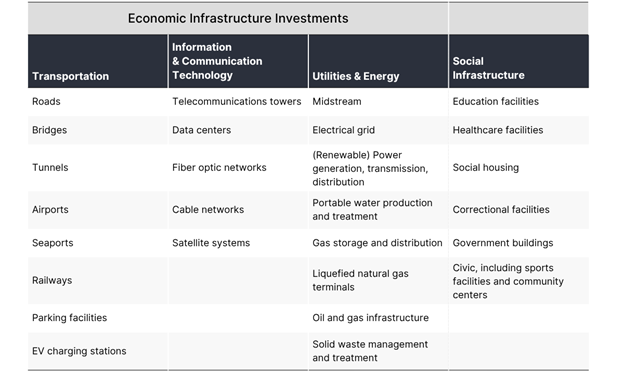
The global infrastructure landscape is rapidly transforming, extending far beyond the traditional idea of roads and railways. Today, it encompasses a wide array of essential assets that facilitate the functioning of our economies and enhance the quality of our daily lives.
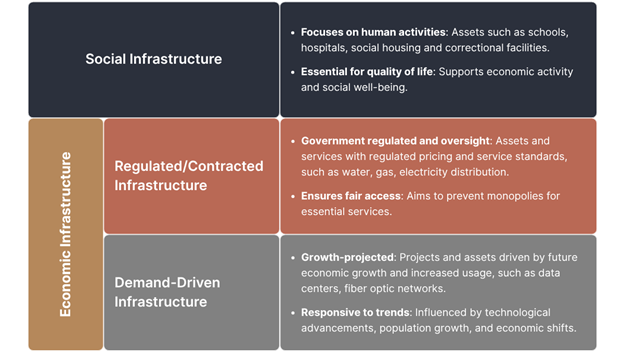
From the vital systems that support our well-being (also known as social infrastructure), such as schools and healthcare facilities, to the networks powering our digital age (also known as economic infrastructure), such as data centres and fibre optic networks, infrastructure is all around us.
Understanding the breadth and depth of modern infrastructure is key to navigating today’s complex and uncertain landscape.
The DNA of Essential Assets
Shifting our focus to the fundamental characteristics that make up the DNA of these essential assets, infrastructure assets possess unique and defensive attributes that differentiate them from other asset classes and are conducive to their compelling investment profile.
These include:
- High barriers to entry, due to significant capital requirements, regulatory controls, and complexity.
- Inelastic demand, leading to lower sensitivity to fluctuations across business cycles.
- Long operational lives, serving as the backbone to global societies and economies.
- Revenues underscored by long-term contracts, offering greater visibility of future cash flows.
- Macroeconomic-linked factors, enabling asset operators to pass through cost increases.
- High operating margins, deriving from relatively low operating costs, which can help grow profitability over time.
These inherent strengths explain why private infrastructure is considered a foundation for portfolio stability, resilience, and long-term value creation.

Understanding the Asset Lifecycle
Infrastructure investments have long been attractive for their potential for stable, long-term returns, often characterized by predictable contractual cash flows. However, the conventional perception of infrastructure, primarily focused on mature assets such as roads and railways, often overlooks the full picture of an asset’s lifecycle. It’s not just about the finished asset itself, but the active development, construction, and operational enhancements that drive growth in asset values.
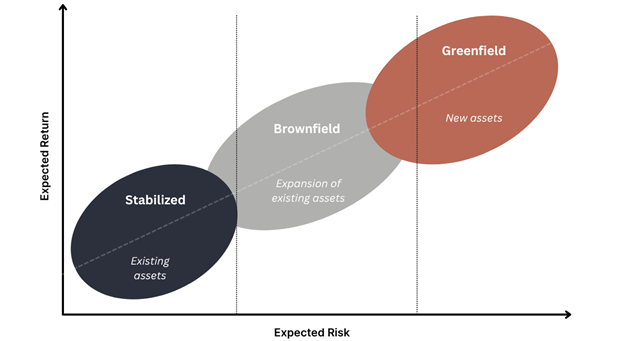
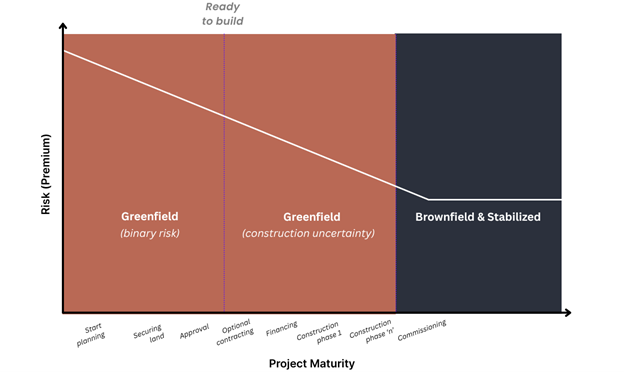
Below, we examine how risk and return profiles evolve across the infrastructure curve, illustrating how a project’s maturity affects its risk premium. Understanding the distinct characteristics of Greenfield, Brownfield, and Stabilized stages of an asset’s life is imperative for investors.
- Greenfield assets represent new, often large-scale projects built from the ground up. At this initial stage, operational uncertainty is highest, encompassing both binary risk (will it be built at all?) and construction uncertainty (will it be completed on time and on budget?).
- As projects advance, they typically move into the Brownfield stage. This involves the expansion of existing assets or significant upgrades, carrying a moderate risk profile compared to Greenfield development.
- Stabilized assets represent fully operational, mature infrastructure that generates consistent, predictable cash flows. Here, the asset is de-risked, and its operational stability commands a lower expected return profile relative to earlier stages.
During the Active Value Creation phase (construction, expansion, and operational improvement), asset value is actively built. Investments during this phase tend to result in a tax treatment equal to capital gains, creating tax efficiency for Canadian investors.
The Spectrum of Infrastructure Strategies
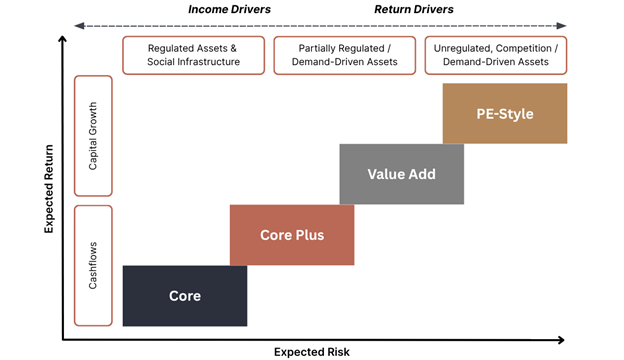
Infrastructure covers a broad spectrum, ranging from rate-regulated, utility-like assets that resemble fixed income proxies to competitive, specialized assets where market demand and secular trends drive growth. Understanding where a strategy falls on this continuum is key for aligning risk, income stability, and growth potential with investors’ objectives.
Below, we explore the four broad strategy buckets anchoring this spectrum:
- Core: Fully stabilized, essential assets in developed markets. Revenue is set by regulation or long-dated contracts, so cash flows are predictable and inflation-linked. Risk is low and objectives skew toward consistent income over long horizons.
- Core Plus: Brownfield assets that might need modest capex or efficiency upgrades. Revenues remain mostly contract-based but carry some exposure to GDP or volumes. Offers a blend of steady income and measured growth, with moderate sensitivity to economic cycles.
- Value Add: Significant expansion or repositioning of assets with very selective, well-underwritten projects. Revenues can range from long-term contracts to shorter ramp-up agreements linked to economic activity or demographic growth. Active ownership and operational value creation unlock capital appreciation. Often overlaps with PE-style approaches, sharing hands-on growth approaches, execution-focused management, and may selectively incorporate new construction.
- PE-Style: New construction or complex developments in competitive, niche assets, requiring significant capex or upfront capital. Revenues are price- and volume-sensitive, leading to higher uncertainty but greater potential for outsized growth. Managers generally pursue build-scale-exit strategies.