
Over the past few weeks, people have asked me, “What is the future of private investments?”
To answer that, we need to look at the bigger picture, because what we are experiencing today is not the end of private markets, but a turn in the cycle.
The Cycle: From Fragmentation to Institutionalization to Friction
Before the 2020s, private investments were largely fragmented. They were small, local opportunities, often distributed through exempt market dealers to high-net-worth individuals. That model came to a halt following high-profile failures, such as Bridging Finance. Confidence broke. Dealers tightened their shelves. Smaller managers were effectively shut out. What is worth noting is that these types of failures are not exclusive to private markets; public markets also have examples of companies that failed due to governance issues.
Then came the private market renaissance.
From 2020 to 2025, private markets re-emerged, but in a new form. Large, institutional, global managers like Blue Owl, Blackstone, Partners Group, and KKR led the charge by offering their strategies, once reserved for institutional investors, to mass-affluent families. From here, the narrative began to shift. Private meant institutional. Institutional meant quality. Quality meant safety.
Advisors and investors across all levels of sophistication adopted private markets at scale.
This was the flow. Today, we are in the ebb.
Over the past year or so, concerns around valuation, liquidity, and asset quality have surfaced. Redemption limits across multiple asset classes have brought a structural reality back into focus. Private investments are not just about return. They are about liquidity trade-offs.
Investors questioning whether private investments are worth the potential illiquidity is understandable, but the real opportunity lies in rethinking how the asset class is used, not abandoning it.
The Euthyphro Dilemma of Private Markets
“Is the pious loved by the gods because it is pious, or is it pious because it is loved by the gods?” — Plato, Euthyphro
At the peak of the cycle, a subtle shift occurred.
Did investors value investments because they were private, or were they private because investors valued what that structure enabled?
For many, the answer became the former.
Private turned into a signal of quality. Illiquidity became synonymous with sophistication. Smoothed valuations became lower volatility. Access became exclusivity, and exclusivity implied quality.
The result was clear. Capital began chasing the structure (form) rather than the underlying economics (function).
This is classic late-cycle behaviour, not unlike Veblen goods, where something is perceived as valuable because it is expensive. In private markets, something became attractive because it was private.
But being private is not an asset class. It is a form, not a function.
Private Markets Did Not Fail
Private markets did not fail. Investors’ understanding of how to appropriately integrate them in a portfolio did. Investors did not fall out of love with private markets. They fell out of love with mistaking structure for substance.
Private investment structures can be powerful, but only when they enable something specific. Long-term execution without short-term pressure. Access to opportunities unavailable in public markets. Capital formation during periods when public markets are constrained.
In public markets, management teams prepare fastidiously for quarterly calls with analysts, answering a single, persistent question: “What have you done for me in the last 90 days?” Such management teams are rarely rewarded and often penalized for pursuing long-term projects, forcing them to proceed with extreme caution, often with their careers on the line. Capital-intensive infrastructure and development projects, which require years to realize returns, can make or break a management team, unlike in private markets, where capital is structurally more patient.
Another example of when form enabled function was during the 2022 drawdown, where many public REITs were effectively shut out of the capital markets. Private REITs continued to raise capital and deploy it into opportunities, generating years of embedded growth in their portfolios.
In this context, being private was not a feature. It was an enabler.
What This Cycle Is Teaching Us
The current environment, while uncomfortable, is productive.
We are already seeing evolution across the ecosystem. Dealers are strengthening risk management frameworks. Advisors are becoming more sophisticated in due diligence. Product quality and institutional discipline are improving.
More importantly, investors are learning what actually matters. Liquidity management. Valuation integrity. Governance and transparency. Portfolio construction and position sizing.
On the issuer side, fund managers are adapting as well. Broader and more global investor bases, more consistent valuation processes, and clearer communication around investor expectations.
Like a forest after a fire, the system is resetting, and what emerges will be healthier and more resilient.
The Path Forward: From Exposure to Intentionality
Private markets are not disappearing, but their role in portfolios is evolving.
The question is no longer whether I should own private investments. It is what role private investments should play, and why.
Avoiding portfolio volatility should not be the primary objective of investing in private markets. It should be a secondary benefit driven by intentional capital market views.
If you have conviction in areas such as farmland, data centre development, real estate dislocations, or private credit opportunities, then private markets may be the only way to express that view.
But that exposure must be deliberate, understood, and sized appropriately within the portfolio.
Final Thought
Private markets did not fail. The current point in the private capital market cycle simply exposed where discipline was lost.
At a high level, the long-term trajectory of private markets remains intact. According to Pitchbook’s Private Capital Index, which aggregates the performance of various private asset classes, private markets have outperformed the S&P500 TR by 138% since 2000. But that growth has not been linear. Private markets have gone through cycles, with periods of expansion, excess, recalibration, and renewal just like public markets. Each cycle has reinforced the market’s foundation, improved its structural integrity and expanded both breadth and depth. What we are experiencing today is part of the same pattern.
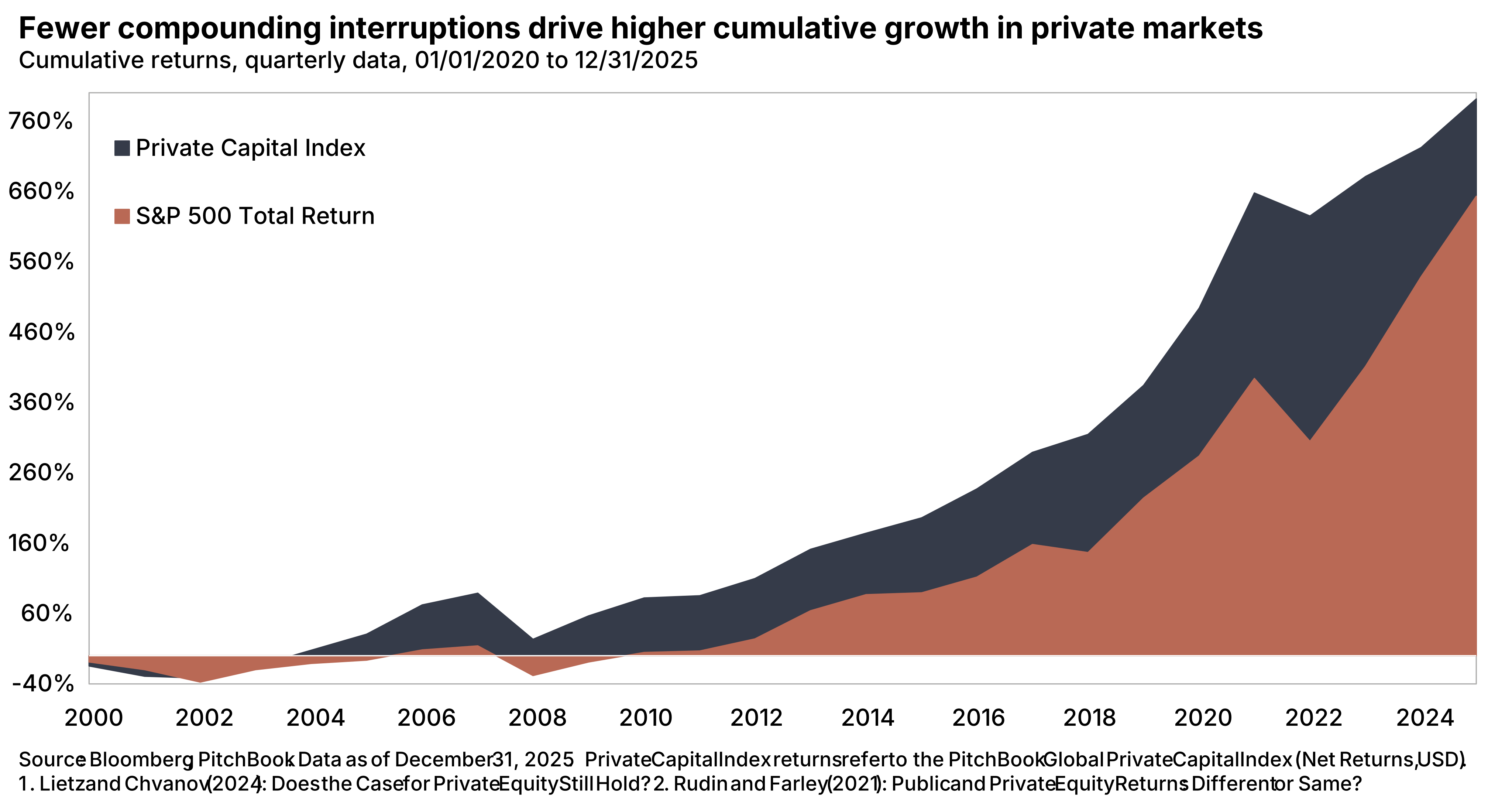
The next phase will not be defined by abandoning private investments, but by using them more thoughtfully.
Don’t invest in private markets because they are private. Invest in private markets because being private enables something worth owning.