
Investing has always required judgement. For decades, that judgement was largely built on fundamental research, qualitative assessment, and trading expertise. While these remain essential in the investment process, the volume and variety of information available to aid the judgement process have expanded dramatically, particularly with the proliferation of artificial intelligence.
The challenge for investors is no longer accessing information, but exercising discernment. This requires the ability to validate the integrity, accuracy, and reliability of data, distinguish true signals from noise, and act on those signals consistently.
Advancements in technology and computing power have transformed the investment landscape, allowing Managers to process and analyze information at a scale that was previously impossible. Systematic investing – what was once a niche quantitative discipline has now become a significant element of institutional asset allocation that can provide access to a broader set of opportunities.
What is Systematic Investing?
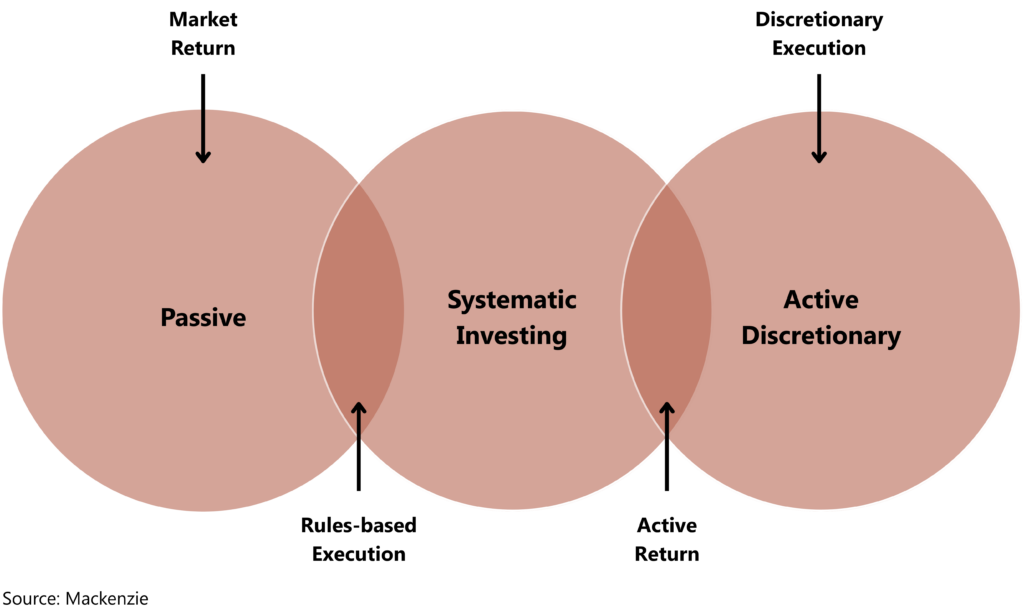
Traditional discretionary approaches have primarily relied on human judgement. Managers make decisions based on their experience, intuition, and fundamental research. Passive investing, by contrast, seeks to track a market index or benchmark with minimal active decision-making. Systematic investing sits between the two, combining human judgement with quantitative tools and data-driven techniques to evaluate information consistently at a greater scale (Exhibit 1).
At its core, systematic investing is not about replacing human decision-making in the discretionary approach or replicating a static model trading strategy in the passive approach. Rather, it is about enhancing it. Human expertise remains essential in developing investment ideas, validating research, overseeing risk, and adapting strategies as markets evolve. Advanced technology serves as a tool that extends these capabilities, allowing Managers to pursue opportunities with greater breadth, consistency, and scale.
Exhibit 1: Systematic investing sits between passive indexing and fully discretionary active management.
Turning Data to Insight
Systematic Managers analyze a broad range of inputs, including company fundamentals, market prices, economic indicators, investor sentiment, and alternative datasets. These inputs are evaluated through a disciplined research process to identify signals that may be associated with future investment outcomes (Exhibit 2).
However, effective signals require more than identifying historical patterns. Each signal must be supported by sound economic rationale, tested across different market environments for its durability and effectiveness. A signal that looks attractive in isolation may be less valuable if it duplicates existing exposures, lacks persistence, or cannot be implemented efficiently.
Exhibit 2: The systematic process is a structured pipeline that transforms data into portfolio decisions.
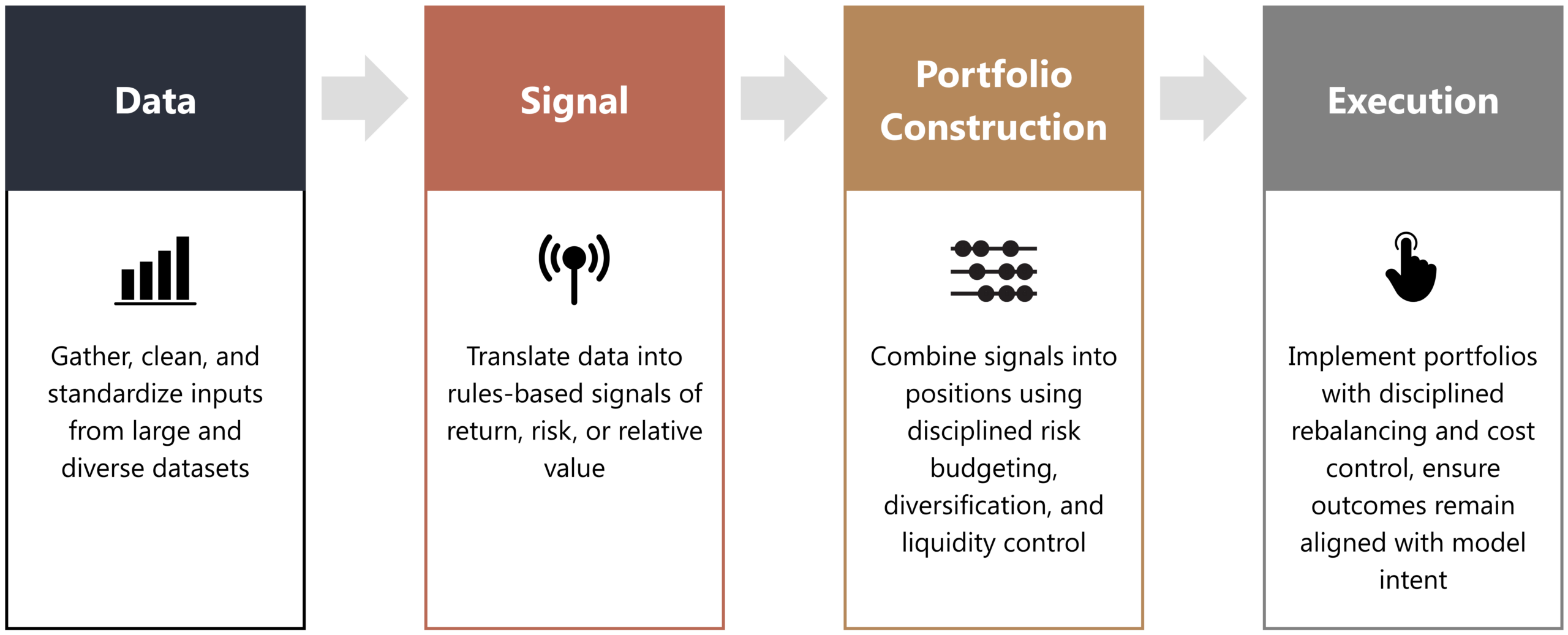
The systematic process can be explained using a retailer as an example. A traditional analyst may review same-store sales, margins, management commentary and valuation. A Systematic Manager can evaluate those same fundamentals but may also incorporate alternative data such as foot traffic at store locations, online search activity, and transaction trends.
A Systematic Manager may start with foot-traffic data to assess whether customer activity at a retailer’s store is improving. But the raw data alone is not enough. A solid research process would normalize for holidays, weather, regional differences, store openings, one-off events, and seasonality, and test whether the foot-traffic signal meaningfully predicts sales or earnings momentum across companies and market environments. In addition, they would evaluate whether the signal adds incremental information beyond more traditional inputs such as earnings revisions or price momentum.
The result is not a “black box” prediction. It is an evidence-based insight: if operating data is improving before consensus expectations have adjusted, the stock may have a higher probability of outperforming peers. If the data does not hold up after testing, it is refined or discarded.
A similar process can be applied in small-cap and less-covered segments, where broker research and corporate news flow can be translated into sentiment scores using large language models (LLMs). Initial sentiment measures are stress-tested for coverage bias, noise around short-term headlines, and crowding risk, and then iteratively improved so that the final signal focuses on persistent changes in the language around fundamental and outlook. By re-testing through different market environments and after realistic transaction costs, Systematic Managers can assess whether sentiment data truly improves stock selection, rather than adding noise or unnecessary trading activity.
This is where research becomes a key differentiator. Leading Systematic Managers continuously test, refine, and validate their models as markets evolve and new information becomes available. The objective is not to predict the future with certainty, but to improve the decision-making by combining many independent insights within a disciplined and scalable framework.
Systematic Strategies in Practice
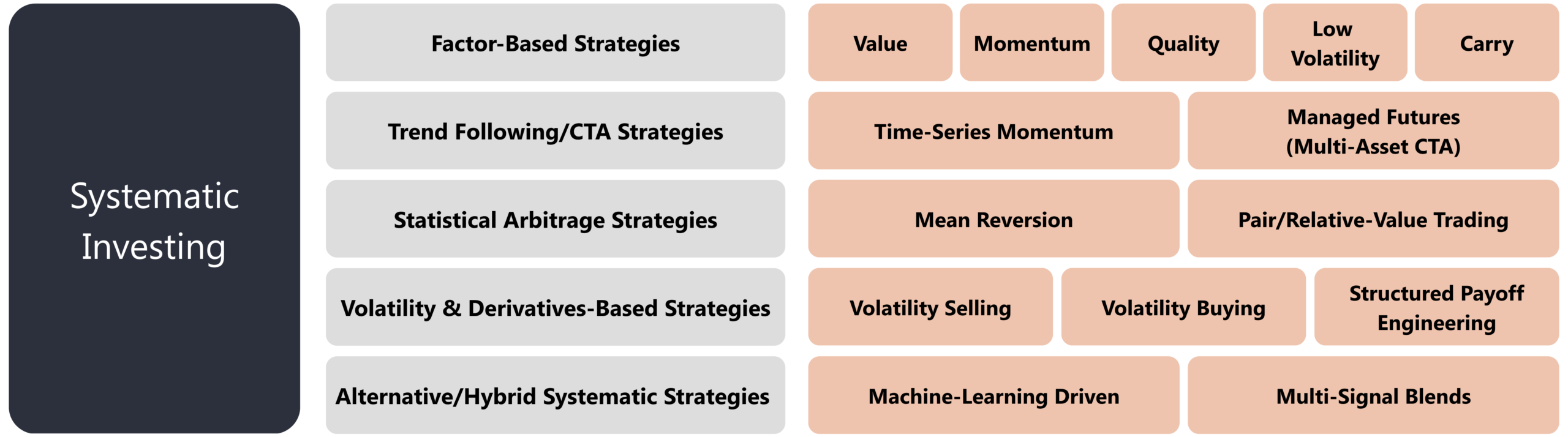
Systematic investing is not a single strategy, but a broad investment framework that applies repeatable, research-driven rules across multiple sources of return, including equities, rates, credit, macro markets, and securitized assets (Exhibit 3). In practice, this means portfolios can combine long/short equity selection, trend and macro trading, relative-value positions in rates and credit, and capital-structure or securitized-credit opportunities within one integrated process. The result is a more diversified set of return drivers than what would typically be available from a traditional long-only portfolio.
Exhibit 3: Systematic investing encompasses multiple strategy families, each designed to capture distinct return drivers across markets, time horizons, and instruments.
Three common examples include:
Equity Cross-Market Security Selection: In equity markets, Systematic Managers may analyze company fundamentals, analyst revisions, earnings visibility, investor positioning, and capital flows across sectors. For example, if data shows improving earnings expectations and stronger business activity in technology and financials, while real estate and energy face pressure from higher rates or weaker profitability, the portfolio may tilt long toward the stronger sectors and short the weaker ones. The objective is not simply to predict which sector will perform best, but to identify relative winners and laggards using a consistent, evidence-based process.
Credit-Informed Equity Long/Short: Systematic Managers may also combine information from credit and equity markets. Credit spreads can sometimes confirm or challenge what equity prices are implying. For example, if a company shows better-than-expected sales and profits, and its credit spreads are tightening, the combined signal may suggest improving fundamentals. That insight can support a long equity position. This approach is useful because different markets often process information at different speeds. Credit markets may reveal changes in risk perception before they are fully reflected in equity prices, or vice versa.
Credit Long/Short: In credit markets, systematic strategies may compare bond spreads against estimated default risk, leverage, operating performance, and equity market signals. For example, one company may offer attractive credit compensation because spreads are wide while fundamentals are improving. Another may have tight spreads despite weaker fundamentals. A Systematic Manager may go long the more attractive credit and short the less attractive one. The goal is to capture relative mispricing while reducing broad market exposure. In other words, the strategy seeks to profit from differences between issuers, rather than relying only on whether the overall credit market rises or falls.
Where Systematic Investing Fits in a Portfolio
A traditional portfolio often relies heavily on equity market growth and bond market stability. Systematic strategies can broaden the opportunity set by investing across asset classes, geographies, sectors, securities, and time horizons. Because many systematic strategies are designed to capture relative-value, trend, factor, or cross-market opportunities, their returns may be driven less by broad market direction and more by security selection, market inefficiencies, and disciplined portfolio construction.
A disciplined systematic process can also help identify exposures, size positions appropriately, and manage risks such as concentration, liquidity, factor exposure, and drawdown. In addition, the ability to evaluate many signals across many markets can help Systematic Managers respond more quickly when market leadership shifts or when traditional relationships break down.
By using data and technology to identify a broader range of opportunities, Systematic Managers may be able to capture small but repeatable sources of alpha across many securities and markets. Individually, each signal may be modest, but when combined within a diversified portfolio, these insights can become a meaningful source of active return.
This does not mean systematic investing is risk-free. Models can be wrong, signals can decay, transaction costs can erode returns, and crowded trades can unwind quickly. For this reason, Systematic Manager quality is critical. Strong research, robust data, disciplined portfolio construction, risk oversight, and execution capability are essential to turning systematic insights into durable portfolio outcomes.
The Case for Systematic Investing Today
The investment landscape has become increasingly complex in recent years. For much of the post-GFC period, investors benefited from low inflation, accommodative monetary policy, and a stable relationship between stocks and bonds, where bonds helped cushion the impact during periods of crisis.
That correlation turned positive in the aftermath of COVID-19. In 2022, both US equities and core bonds posted double-digit losses as inflation surprised to the upside and central banks raised interest rates aggressively. This challenged the traditional 60/40 portfolio playbook and reminded investors that bond diversification cannot always be taken for granted, particularly when inflation and rate shocks affect both asset classes at the same time.
Interest rates have also reset to a higher range. After more than a decade of unprecedented quantitative easing at near-zero rates, central banks began one of the fastest tightening cycles in decades. The 10-year U.S. Treasury yield briefly moved above 5% in October 2023, its highest level since 2007, reflecting a sharp repricing of inflation, policy, and term-premium risk. Since then, markets have continued to adjust between expectations for rate cuts and concerns that inflation could remain more persistent than expected.
Geopolitical tensions have added another layer of uncertainty. Russia’s invasion of Ukraine reshaped global energy trade flows and contributed to broad inflation pressure, while conflict in the Middle East has disrupted key shipping routes, increased transit times, and raised freight and fuel costs. These shocks can trickle down quickly through commodities, currencies, interest rates, and regional risk premia, negatively impacting growth and, ultimately, corporate margins.
At the same time, market outcomes have become more differentiated, as observed in the Dispersion Index that tracks the performance spread between winners and losers (Exhibit 4). Recent market performance has been driven by narrow leadership in AI-linked industries, with information technology and semiconductor stocks delivering outsized gains alongside strength in energy and select financials, while more rate-sensitive areas such as real estate and consumer discretionary sectors have lagged, posting flat or low single-digit returns in many markets. This wider dispersion creates challenges for portfolios that rely mainly on broad market exposure, but it can also create opportunities for strategies that can identify relative winners and losers.
Exhibit 4: Market conditions support systematic alpha generation
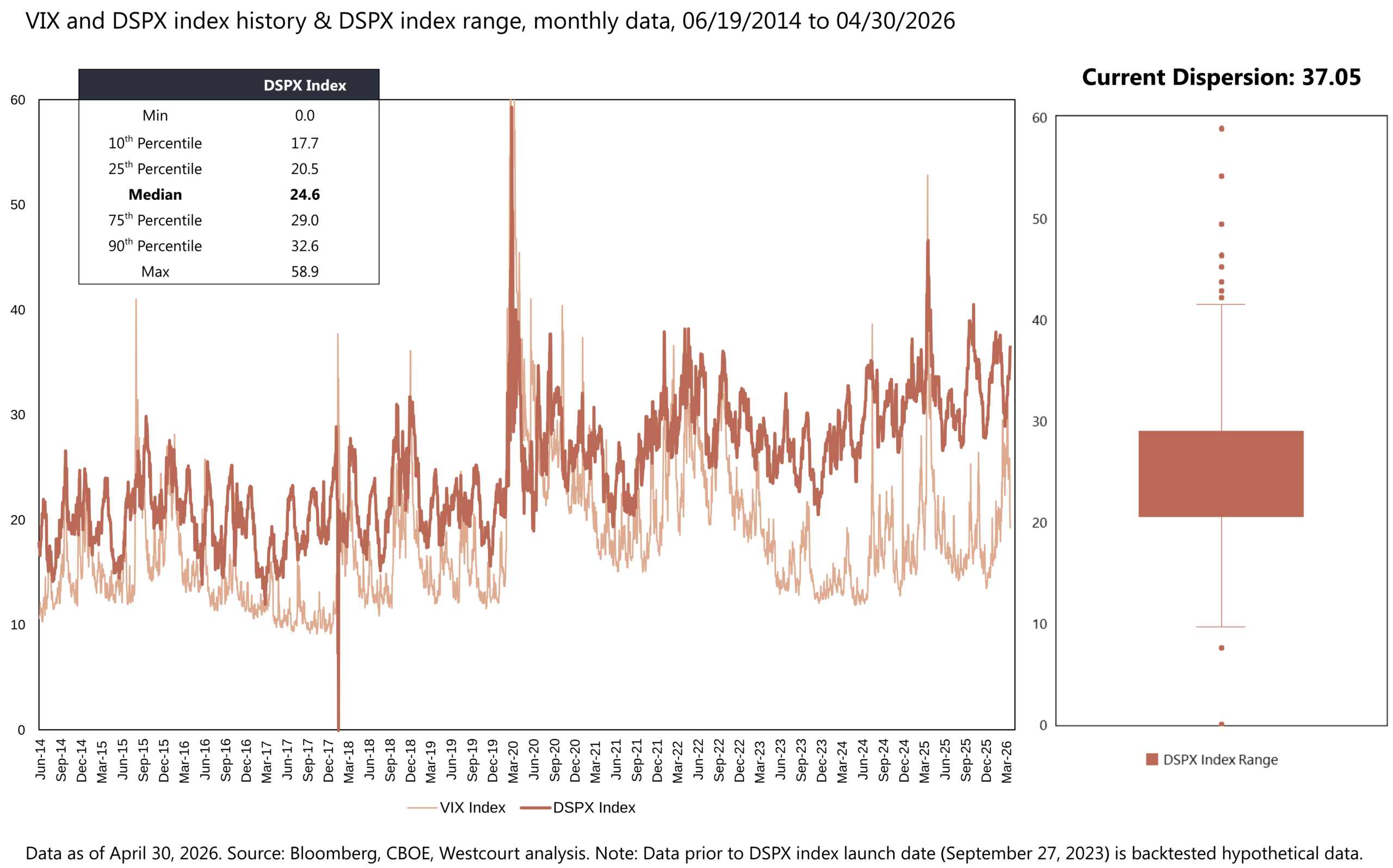
This is where systematic investing can be particularly relevant. By using data-driven and rules-based models, systematic strategies can evaluate a large volume and range of signals across markets and respond tactically as conditions change. For example, in equities, systematic market-neutral and factor-based strategies may use signals such as valuation, balance-sheet quality, earnings revisions, price momentum, and sentiment to build diversified long/short portfolios. When dispersion is elevated, these strategies can tilt toward companies with improving profiles and away from those showing deterioration, seeking to capture the relative performance gap between market leaders and laggards.
The strength of systematic investing today is not simply its use of technology or data. Rather, it is its ability to diversify return drivers and pursue opportunities that may be less dependent on the direction of traditional equity and bond markets.
When Hiring a Systematic Manager
Not all Systematic Managers are created equal. While many strategies may appear similar at a high level, outcomes can vary significantly depending on the depth of the research behind them.
Research Capability: A strong research process is essential for identifying and validating new investment signals. This research-driven culture is often what distinguishes leading Systematic Managers from their peers.
Data Advantage: The quality, breadth, and interpretation of data are central to systematic investing. A Manager’s ability to source, clean, analyze, and effectively use large datasets can be an important differentiator.
Portfolio Construction Expertise: Generating signals is only the first step. Successfully translating those signals into portfolios requires thoughtful risk management, diversification, liquidity awareness, and implementation discipline.
Technology Infrastructure: Systematic investing depends on robust technology, data management, and analytical capabilities. Scalable infrastructure allows Managers to process information efficiently and implement decisions consistently across markets.
Experience and Governance: Human oversight remains critical. Investors should evaluate the experience of the investment team, the strength of the risk management framework, and the governance processes supporting model development and portfolio decisions.
Key Takeaways
Systematic investing combines human insight with advanced quantitative techniques to pursue investment opportunities across asset classes. Its value lies not only in the use of data and models, but in the strength of the research, portfolio construction, risk management, and governance behind the strategy.
In an environment of higher stock-bond correlation, shifting rate expectations, geopolitical uncertainty, and wider dispersion across securities, systematic strategies may offer investors a broader and more diversified way to pursue alpha. By turning information into tested signals and signals into controlled portfolio actions, systematic investing can help investors access opportunities that may be difficult to capture through traditional approaches alone.